


By June 18, 2024 Financial education
Most of my clients with children rank saving for college as one of their top financial goals, second only to either saving for a home or for retirement. Your student may have worked very hard and have an ideal school in mind, with one or two “safety schools” as a backup plan. Maybe they’ve been working and saving some of their own money to put towards college, and it’s possible you have some family members eager to chip in to help. The perfect time to start saving is now.
Keep in mind that saving for future college expenses, even with modest monthly contributions, can grow into a substantial amount towards expenses that may include tuition, room and board, computer equipment, books and supplies, and more. I like to remind parents to think about college as an investment in your child’s future. The student who understands that their parent or parents have made this commitment may very well work harder to achieve the goal of getting into the college of their choice.
Bureau of Labor Statistics data from 2022 illustrates that persons age 25 and over who’ve earned a bachelor’s degree had median weekly earnings 60% higher than those with only a high school diploma along with lower overall unemployment rates.
Today’s 529 plan offers numerous advantages, with more flexibility than ever before. Anyone can open a 529 savings plan, regardless of their income. The account owner controls the account and how the money is spent and it is possible to change the beneficiary to another family member if the intended recipient doesn’t attend college or trade school. The funds in the 529 plan can also be used for K-12 education, study-abroad programs, international schools, some apprenticeship programs and student loan expenses (up to $10,000). Additionally, there is a new option that allows for unused funds in the 529 plan to be rolled over into a Roth IRA. The best part? There is no penalty for doing so! Details to know:
• In order to do a rollover the 529 plan must have been opened and active for 15 years.
• Contributions made in the last five years began are not eligible for rollover.
• The 529 beneficiary must also be the Roth IRA owner.
• Roth IRA annual contribution limits and earned income rules apply.
• The lifetime maximum rollover limit is $35,000 from a 529 to Roth IRA.
• The rollover must be completed as a direct transfer from the 529 plan program to the Roth IRA custodian.
What this means for parents is that the new rules can give your children a jumpstart on saving for retirement with leftover funds in the plan.
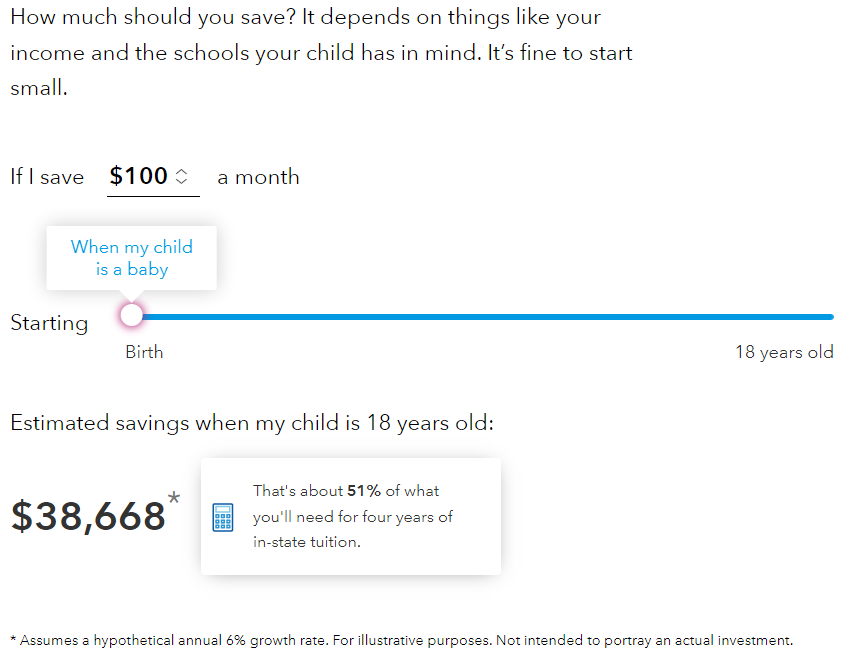
Beginning a monthly automatic investment plan can make a difference. Even if your goal seems overwhelming now, with proper planning and saving you can build up a down payment for any college. Consistency in saving is key. The illustration below shows how saving $100 per month for your newborn child has the potential to grow over time to give your child a head start on college costs.
In addition, often times family members would like to participate in helping save for the child. Grandparents, in particular, can utilize 529 savings plans as an estate planning vehicle for contributing to fund the child’s education. Some of the benefits of this allow grandparents to gift up to $18,000 or $36,000 for married couples annually without gift-tax consequences. There is also a special election or ‘superfunding’, allowing a one-time contribution prorated over five years up to $90,000 or $180,000 for married couples. The earnings from the gift grows tax-free in the 529 savings plan.
When it comes to financial aid, it is more beneficial for eligibility to have college savings assets owned by the parent, as student assets are weighted at 20% of overall assets, compared to parental assets, which are weighted at 5.64%. This makes a strong case for using 529 plans to save for college as opposed to a UTMA (Uniform Transfers to Minors Act) account or Minor Savings account. New for the 2024-2025 award year, grandparent-owned 529 savings plans, with the grandchild as a beneficiary, are no longer considered assets in FAFSA eligibility assessments. This can increase the overall financial aid package for students using FAFSA alone to determine their financial aid award.
So, what are you waiting for? Take advantage of the flexibility and tax advantages that exist within the 529 savings plan and know that when it comes to saving for college with a 529 savings plan, you have some unique options to consider.
If you’d like to receive a report outlining the annual costs for a college your child is considering and/or a monthly savings plan to reach that goal, please reach out to me.
Joanne Wagner, Financial Advisor
joannewagner.cfsinvest@veritycu.com
206.361.5383
¹Source: U.S. Bureau of Labor Statistics, Current Population Survey
• The information being presented herein does not consider your particular investment objectives or financial situation and does not make personalized recommendations. This material is not intended to replace the advice of a qualified tax adviser or legal counsel. Individuals should contact their own tax professionals and attorneys to help answer questions about specific situations or needs prior to taking any action based on this information. We believe the information provided is reliable, but do not guarantee its accuracy, timeliness, or completeness. “
• Non-deposit investment products and services are offered through CUSO Financial Services, LP ("CFS") a registered broker-dealer (Member FINRA/SIPC) and SEC Registered Investment Advisor. Products offered through CFS: are not NCUA/NCUSIF or otherwise federally insured, are not guarantees or obligations of the credit union, and may involve investment risk including possible loss of principal. Investment Representatives are registered through CFS. The Credit Union has contracted with CFS for investment services. Atria Wealth Solutions, Inc. ("Atria") is a modern wealth management solutions holding company. Atria is not a registered broker-dealer and/or Registered Investment Advisor and does not provide investment advice. Investment advice is only provided through Atria's subsidiaries. CUSO Financial Services, LP is a subsidiary of Atria.
The information provided on this blog is for general informational and educational purposes only. All content is written in good faith and is intended to be accurate as of the date of publication. However, laws, regulations, industry standards, and best practices may change over time, and information may become outdated.